Product · Hardware
4× DGX Spark, 400GbE backbone, one cabinet.
No vendor lock-in, no proprietary black box: a curated complete system that your own IT team can operate and maintain.
Measured values for KI:KUBE 4; actual values depend on configuration and are binding in the quotation.
* Uniform 19-inch rack for KI:KUBE 2 / 4 / 6 / 8. The KI:KUBE 2-slim (2 Sparks) is available as a compact 10-inch variant: different form factor, without the 400GbE inference switch.
In detail
What is inside the box
Four building blocks, designed for productive inference rather than training showcases.
DGX Spark
Four DGX Spark modules with 128 GB of unified memory each form the heart of the KI:KUBE, NVIDIA's inference-centric node, ideal for NVFP4 / FP8 / INT8. The high-bandwidth internal interconnect creates a single unified memory address space of 512 GB.
Models of up to ~400B parameters (e.g. Qwen3.5-397B in NVFP4) run on a single KI:KUBE 4, as do Nemotron-3-Super-120B (512K context) or DeepSeek-V3 (MoE).
MikroTik 400GbE switch
A dedicated 400 GbE backbone (QSFP56-DD) connects the compute nodes: each Spark is attached at 200 GbE. This makes tensor-parallel and expert-parallel topologies (TP, PP, EP) possible at full performance.
A 10 GbE uplink to your LAN is all that is needed externally; internal traffic stays inside the cabinet.
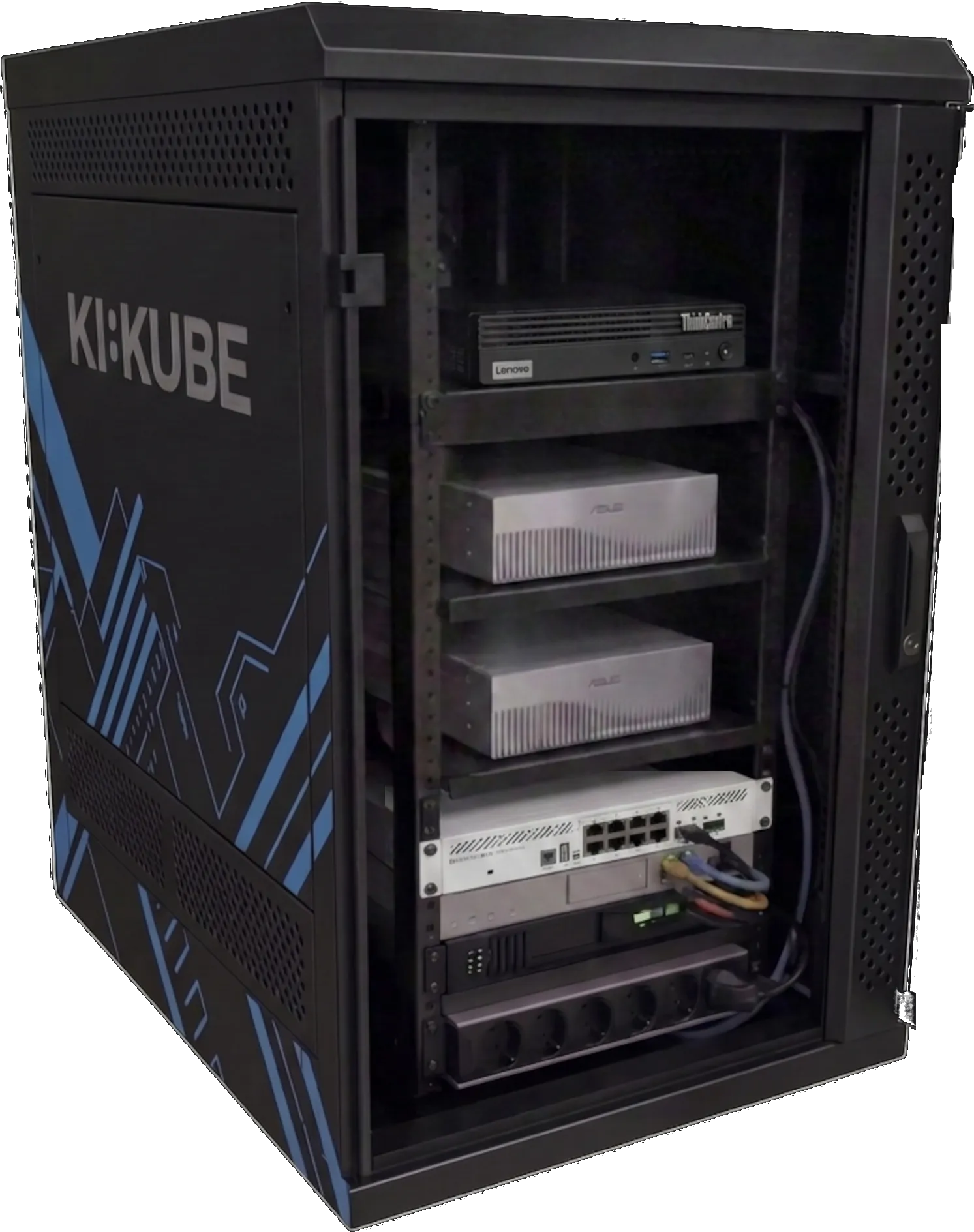
19-inch rack, 18 U
KI:KUBE 2 / 4 / 6 / 8 in the same 18 U enclosure*, with slots reserved for later upgrades in the smaller configurations. Under 0.9 kW at full inference load (KI:KUBE 6 guideline value; KI:KUBE 4 around 0.6 kW, measured).
No special cooling system, no water circuit, UPS-ready. Optionally available as a free-standing unit with a discreet outdoor look (e.g. for a reception area).
* Exception: the KI:KUBE 2-slim comes in a compact 10-inch enclosure (2 Sparks, without the 400GbE inference switch).
5–7 years in production
NVIDIA manufacturer warranty of 1 year, statutory warranty under the contractual terms (B2B), extended hardware coverage through our Care plans.
Realistic productive service life of 5–7 years. Models and configuration are Git-versioned: migrating to a newer hardware generation is possible at any time.
Compact variant
KI:KUBE 2-slim
The entry point into the KI:KUBE ecosystem in a compact 10-inch enclosure: two DGX Spark (256 GB unified memory), control node and management switch, without a dedicated 400GbE inference backbone. Ideal for smaller teams, edge sites or as a pilot system ahead of a later move to a full KI:KUBE.
- 2× DGX Spark: 256 GB unified GPU memory
- Compact 10-inch rack instead of an 18 U cabinet
- A single Schuko socket, quiet office operation
- Same software stack as KI:KUBE 2 / 4 / 6 / 8
A direct upgrade of the 2-slim to KI:KUBE 4 / 6 is not possible: the 400GbE interconnect switch and the space in the 10-inch enclosure are missing. The move is made via the regular KI:KUBE in the 18 U rack.
Sovereignty
Vendor-neutral & maintainable in-house
Even the DGX Spark compute modules are an NVIDIA reference design that several OEMs build to the same specification; everything else is standard off-the-shelf hardware anyway. No vendor lock-in, no black box, no obligation to take out a special support contract or to use a gold partner.
Multi-OEM compute modules
The DGX Spark (GB10 superchip) is an NVIDIA reference design: built on the same platform basis by NVIDIA, ASUS (Ascent GX10), HP, Dell, Lenovo, MSI and Gigabyte (enclosure, cooling and controls may differ by OEM). A failed node can be replaced by any OEM unit and is available at retail, with no single-vendor dependency.
Standard hardware around it
Switch, control node, rack and power supplies are off-the-shelf components: spare parts are freely available on the market, often next-day from any distributor. No gold partner, no waiting on a single supplier.
Maintenance with ordinary IT
Operation and maintenance run on standard Linux / Kubernetes skills: no server engineer and no NVIDIA specialist needed. If you prefer, we take it over through Care.
“DGX Spark” here refers to the platform / device class (NVIDIA DGX Spark and OEM systems with an identical specification such as the ASUS Ascent GX10), not necessarily NVIDIA's own device. Which OEM is actually supplied is stated in the quotation and the order confirmation. For details see the disclaimer.
An honest assessment: More individual parts (several nodes + switch + control node) statistically also means more possible points of failure, and the switch and control node are single points of failure with us too. The advantage is not necessarily a lower failure frequency, but repairability and recovery time (MTTR): in the event of a fault, in the worst case you replace a single node instead of sending a whole server in for RMA, and depending on the topology the rest keeps running in a degraded state.
If you want to play it safe, simply put a second KI:KUBE next to it for redundancy, and enjoy double the performance in normal operation 😊
Installation
Power, cooling, floor space
What the installation site has to provide: usually surprisingly little.
Power
1× Schuko 16A is sufficient for all configurations (max. ~0.9 kW at full inference load). Optionally 2× Schuko for redundancy. Soft start.
Cooling
Standard office temperature (up to 27 °C ambient) is sufficient; dedicated air conditioning is recommended for higher utilisation.
Floor space
approx. 1.2 m² including maintenance clearance. Often possible in an existing server room without conversion work.
Noise
At full load, with large, slow-turning fans; noise level well below that of a typical 1U rack server.
See KI:KUBE working on one of your own documents.
Request a demo