Sovereign AI appliance · Made in Germany
Frontier AI.
Your own data.
No cloud.
Turnkey AI appliance for law firms, tax advisors and mid-sized companies.
ChatGPT-level performance on 2 to 6 DGX Spark units (4 recommended), in a single 19-inch enclosure. Your data never leaves your network. Section 203 StGB (German Criminal Code), GDPR and the EU AI Act are solved structurally.
Brussels can regulate. Washington can switch off. KI:KUBE keeps running.
Complete AI appliance solution for anyone for whom sovereignty over their infrastructure and over the processing of proprietary data is business-critical.
The problem
Cloud AI is expensive and risky, and building your own is too complex.
Most companies in Germany that use AI today do so through external, predominantly US-based interfaces. That works for non-critical tasks, but breaks down with client files, patient data and IP-relevant code.
Cloud AI is expensive
30 power users on ChatGPT Pro cost around €2,610 net per month, and prices, quotas and billing models keep changing. Token budgets for agentic workflows quickly get out of hand.
Cloud AI is risky
Client files in US clouds can touch Section 203 StGB. And the legal position on US data transfers remains politically contested. A single incident is enough: professional indemnity cover and reputation are at stake.
Building your own is too complex
GPU cluster, K3s, SGLang, quantisation, monitoring, updates: heavy engineering before the first model answers. And then Validated Profiles are missing.
Why now? The Anthropic case.
On 13 June 2026, on the orders of US government bodies, Anthropic had to block its flagship models (Fable 5 and Mythos 5) for all non-US citizens, and then took them offline entirely. Overnight, Europe was cut off from one of the world's leading AI systems. An unprecedented step: an authority had a commercially deployed AI model switched off by order.
This changes the sovereignty debate. Until now it was mainly about cost: cloud AI is structurally becoming more expensive. The Anthropic case opens a second, harder axis: access. Cloud AI can not only become expensive, it can be switched off by order of an authority.
“Europe has told itself for too long that it is enough to be able to use the world's best AI models. That assumption is not damaged. It is obsolete.”
Cost risk
Subsidised introductory prices are expiring, and the shift to usage-based token billing is driving bills up. At the IT service provider Adesso, token consumption rose almost a hundredfold within six months: tokens are now a six-figure budget item there. A price increase can at least be planned and budgeted for, unpleasant but calculable.
Access risk
A cloud model can be switched off by order: without notice, without a transition period. Losing access on orders from Washington cannot be budgeted for. That is exactly what is new.
According to a KPMG survey, only 26% of companies have a comprehensive overview of their AI costs, and 22% have no transparency at all and only learn the actual spend when the invoice arrives. A fixed on-prem investment removes exactly this unpredictability: known purchase price, known power consumption, no token bill at the end of the month.
Source: KPMG survey, quoted in Handelsblatt · 06/2026
The KI:KUBE answer: sovereignty means owning the inference.
KI:KUBE does not run Anthropic or OpenAI models and does not replace a blocked frontier model one to one. We curate and configure the best open-weight models available at any time (Qwen, Nemotron, GLM, Llama, DeepSeek, GPT-OSS), and they run on your own hardware in your own network. And that is exactly the point:
You cannot be locked out of a model that sits on your own hardware. An open-weight model that is up and running cannot be recalled by any US authority.
Cloud AI has just demonstrated that it can be switched off by order. KI:KUBE has no switch that Washington can reach, and is therefore the answer to both axes: neither the bill nor the order affects something that is plugged into your own socket.
The solution
One box. Power. LAN. Browser. Running.
KI:KUBE is a preconfigured AI appliance. It arrives in a 19-inch enclosure, you plug it in, and it is productive within a morning. No GPU cluster engineering, no model tuning, no update stress.
- Turnkey. Unpack, switch on, open a browser, and get started.
- Local. 512 GB of GPU memory, frontier models, your data stays in-house.
- Compliant. Section 203 StGB, GDPR, EU AI Act Art. 4: addressed structurally.
- Vendor-neutral. Standard hardware, multi-OEM compute building blocks: spare parts from the distributor, no gold partner, no vendor lock-in.
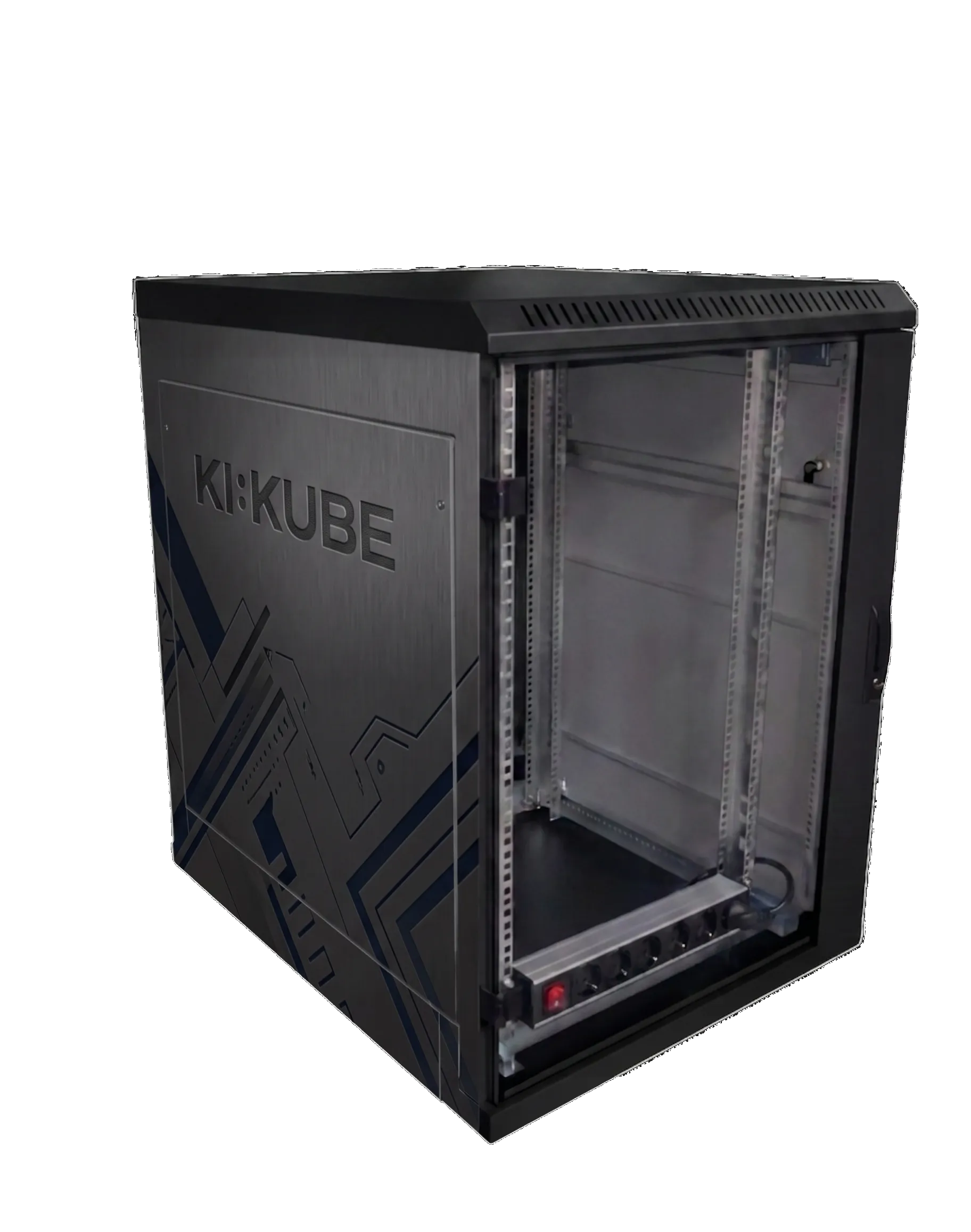
No server room needed
Even the largest configuration runs on a standard power socket.
KI:KUBE 6 draws only ~0.9 kW under full inference load (peaks ~1.1 kW): that fits comfortably on any 16A Schuko socket. No electrician work, no dedicated circuit, no CEE three-phase supply. The uniform 18U sliding rack (19 inch) fits in any equipment room, in a sideboard or behind a partition, with the same box size for KI:KUBE 2 / 4 / 6 / 8, only the fit-out grows. The KI:KUBE 2-slim is also available in a compact 10-inch enclosure.
Comparable on-prem AI solutions at ~5 kW typically need CEE three-phase power or two separate 16A circuits, and therefore building work before they can even be used.
We do not leave you alone afterwards either
The box is running. Now the real work begins.
Almost all German companies want to use AI, yet only a small share use it productively so far. The gap rarely arises at the model, almost always in between: use cases, integration, training. That is exactly where we come in: we are here to make sure you succeed with your KI:KUBE.
Analysis
Use-case workshop (remote or on site on request), walk through your processes, identify 3 to 5 AI levers with a good effort-to-impact ratio.
Customisation
RAG on your documents, n8n flows, API bridges, custom system prompts. Iterative, pragmatic, together with the users.
Deploy loop
Quarterly review, identify new levers, roll out model updates with a risk assessment. Your investment stays productive.
Four sizes: one architecture
From pilot team to 120-user cluster.
KI:KUBE scales in four steps with your needs: same software stack, same operating concept, same power connection. Just more DGX Spark nodes.
KI:KUBE 2
Small teams · 5–10 concurrent chat users · pilot setups
KI:KUBE 4
SMEs · 10–30 concurrent chat users · frontier models (e.g. Qwen3.5-397B)
KI:KUBE 6
Power users · 30–60 chat users in parallel · 150+ async streams for email triage
KI:KUBE 8
Maximum · 60–90 chat users in parallel · 200+ async streams · larger frontier models
User and stream figures are indicative: actual capacity depends heavily on the choice of model.
As an investment in modern IT infrastructure, a KI:KUBE may be eligible for funding: e.g. through the low-interest KfW ERP digitalisation loan. More about funding →
| Spec | KI:KUBE 2 | KI:KUBE 4 | KI:KUBE 6 | KI:KUBE 8 |
|---|---|---|---|---|
| DGX Spark nodes | 2 | 4 | 6 | 8 |
| Unified GPU memory | 256 GB | 512 GB | 768 GB | 1,024 GB |
| FP4 compute (sparse) | ~2 PFLOPS | ~4 PFLOPS | ~6 PFLOPS | ~8 PFLOPS |
| Power consumption under full inference load | ~0.3 kW | ~0.6 kW | ~0.9 kW | ~1.2 kW |
| Power connection | Schuko 16A | Schuko 16A | Schuko 16A | Schuko 16A |
| Form factor | 19″ · 18U | 19″ · 18U | 19″ · 18U | 19″ · 18U |
| Concurrent chat users (p95 TTFT < 2s) | 5–10 | 10–30 | 30–60 | 60–90 |
| Async streams (queueable) | 20+ | 80+ | 150+ | 200+ |
| System purchase (entry) | ~€22,900 | €29,900 | ~€39,900 | ~€49,900 |
| + Faststart bundle (bookable as an add-on) | +€8,180 | +€8,180 | +€8,180 | +€8,180 |
Concurrent chat users = employees who are waiting for a response at the same time (latency SLO). Async streams = queueable background workloads for email triage and agent workflows (daily throughput). KI:KUBE 2, 6 & 8: user figures scaled from the 4-node run.
Software stack
Preconfigured. Versioned. Maintainable.
Five layers, all components open source, all configurations versioned in Git, and the Git repository lives physically on your appliance. No black-box SaaS, no vendor lock-in.
User apps
ChatGPT-style interfaces + email interface
API gateway
Auth, rate limiting, model routing, logging
Inference engines
Validated Profiles · measured, documented
K3s + GitOps
Forgejo on-prem: the source of truth stays with you
DGX OS + GPU + network
NVIDIA hardware base · RoCE-tuned mesh
Multi-model hosting
One cluster, three use cases: in parallel.
KI:KUBE does not have to be reserved for a single model. With the internal model router, chat, RAG embeddings and a coding model run at the same time on the same hardware. You invest once and use it many times over.
Main LLM
Chat, reasoning, research · frontier model (e.g. Qwen3.8-Flash-Next or Nemotron-3-Super-120B) for the demanding requests.
~70% GPU memory
BGE-Embedding
RAG index building and search queries across your own documents · BGE-M3 multilingual for DE/EN with high accuracy.
~10% GPU memory
Coding model
IDE plugin (Continue, Cursor, Tabby, Aider), commit messages, small refactoring tasks · specialised code LLM with low latency.
~15% GPU memory
Utilisation shares are indicative for KI:KUBE 4. The configuration actually used varies with model selection and concurrent load.
Versioned · Observed · Self-healing
Updates as pull requests. Rollback in seconds.
Every cluster change (new model, new engine, new quantisation) lands as a commit in the Forgejo on your appliance. The in-cluster reconciler keeps the cluster in line with the repository.
- ▸ Pod crash detected & automatically restarted (K8s standard).
- ▸ Engine hang detected & previous version rolled back from Git.
- ▸ Complete history: every change annotated, every version reproducible.
↩ Quality regression at v1.4 detected by the gate: automatic rollback to v1.3, customer was notified.
Pre-deploy quality gate
Every update goes through the lab first, then to you.
Before a new model or an engine update is delivered to your KI:KUBE, it runs through 8 standardised benchmarks. We compare the response quality against the running version. Degradations become visible before delivery, and nothing ships until the gate shows PASS.
Reasoning
- ▸ MMLU-Pro
- ▸ GSM8K
- ▸ IFEval (instruction following)
Code
- ▸ HumanEval
- ▸ HumanEval+
- ▸ MBPP+
German
- ▸ MMLU-ProX-Lite DE
- ▸ MMLU DE
- ▸ + word-salad correctness
Three thresholds: one decision
Quality equal or better. Update is delivered.
Delivery only after a documented consultation with the customer.
Update is not delivered. Root-cause analysis in the lab.
pp = percentage points compared with the running version, averaged across all 8 benchmarks. Category-specific thresholds may be set lower.
Customer quality portal Planned from Q4/2026
All gate reports for your configuration via self-service: searchable by history, exportable, with a diff between versions.
Included in the Care packages and Managed, planned availability from Q4/2026.
Async workload · Hermes by email
While you sleep, the cluster works through the queue.
Chat users are not the only type of load. 200+ employees can have their emails triaged by the Hermes agent in the morning: the cluster takes in the queue, works through it over the course of the day and returns prioritised replies. Latency does not matter here, daily throughput does.
- Around 700 tok/s total throughput in the reference configuration (Nemotron-3-Super, 32 parallel requests).
- Up to 32 parallel streams with continuous batching: the queue starts, the cluster pushes through.
- No client setup for the employee: send an email to the Hermes address, the reply arrives in the inbox.
- Also as an assistant by email: Hermes does not only triage incoming emails, you can also reach it directly: write to it as you would to an assistant, delegate research, summaries or drafts, and get the answer by reply.
Productive in 4 steps
From the box to the first answer: one morning.
Unpack
Place the 18U box in an equipment room, a sideboard or behind a partition: no server room needed.
Connect
Power + LAN. The status display shows the IP address.
Browser or email client
Open the WebUI (Open WebUI / Hermes WebUI) on the internal network or send requests to the Hermes agent by email: login via SSO or a local account.
Get started
Frontier models, RAG on your own documents, coding copilot.
Status display on the device
Front panel with a built-in display: current utilisation, ROI ticker (indicative cloud costs saved, in €), cluster health, active models. Visible to the CEO and IT management without anyone having to open the dashboard.
The relevant information at a glance.
Illustrative live preview · synthetic sample data
Sovereignty · Made in Germany
German provider, German jurisdiction, on-prem source of truth.
“Made in Germany” is more than a badge. It means concrete differences when you work with the GDPR, the BfDI or sub-processors, and when you want to exit tomorrow.
German provider directly within the scope of the GDPR
- ▸ BfDI / LDA as the competent data protection authority: no foreign authority constellation.
- ▸ German jurisdiction: disputes over contracts or damages stay within German law.
- ▸ Standard DPA under Art. 28 GDPR as a contract annex: German contracting party, German processing. No Schrems II workaround with SCCs + EU-US DPF + residual risk needed.
- ▸ Simpler sub-processor topology if you want to exclude US subprocessors: the KI:KUBE operating plane (update distribution, support) runs on Hetzner in Germany.
The source of truth stays with you
Configuration, model profiles and history run in the on-prem Forgejo on your appliance: not with us, not in a cloud, not abroad.
- ▸ Even if we disappear tomorrow: you keep the cluster, history and manifests in full.
- ▸ A handover protocol at the end of the contract is a standard annex: no lock-in, no leverage.
- ▸ Models are open-weight (Hugging Face), data is in standard formats: complete data portability.
Industries
Who KI:KUBE is built for.
Wherever cloud AI fails on data sovereignty, professional secrecy, competitive IP or simply planning security.
SMEs & mid-sized companies
For anyone unwilling to accept business data flowing to US AI providers, and who needs predictable prices and stable features instead of constantly changing billing models.
Details & use cases →Law firms
Analyse client files, review contracts and draft pleadings without client data ever leaving your firm.
Details & use cases →Tax advisors & auditors
AI for client-confidentiality-safe work on annual accounts, management accounts analysis and research in the DATEV environment.
Details & use cases →Software companies
A local coding copilot with IP protection. Your source code trains no one else's models.
Details & use cases →Healthcare
Patient data stays in the hospital network. Section 203 + GDPR + patient records: addressed structurally.
Details & use cases →Public sector
Case processing with local AI. No US cloud, no Schrems II risk, suitable for environments compliant with BSI baseline protection.
Details & use cases →Engineering firms
Technical documentation, requirement specifications and design specifications, built on your own knowledge, with no data leakage.
Details & use cases →EU AI Act Art. 4 · mandatory since 2 February 2025
AI literacy training: legally mandatory. Included in our package.
The obligation has applied since 2 February 2025: all companies that use AI must train their employees in AI literacy. From 2 August 2026, national enforcement applies. Art. 4 is not in the quantified EU fine catalogue, but it is not free of sanctions either: national authorities can impose penalties under national law, and liability risk and the burden of proof come on top. Included in the KI:KUBE Faststart bundle: no separate search, no documentation gap.
- ▸ Flat rate for up to 25 participants
- ▸ Certificate per participant
- ▸ GDPR-compatible curriculum
- ▸ Audit-ready documentation
Voices
What the trade press and practitioners say.
Indirect quotes, taken in substance from publicly available articles: sources are linked in the press review.
“Anyone who needs frontier AI on a permanent basis cannot avoid local hardware. Otherwise the cloud bill goes through the roof.”
“For mid-sized inference workloads, the DGX Spark architecture is what the workstation was for the workstation: quiet, local, sufficient.”
“Internally we have seen costs explode. Tokens are now a significant budget item in the six-figure range.”
“To keep costs under control, and for data protection reasons, local models will gain in importance: directly on your own hardware, in the company's own data centre.”
“What still looks like freedom to experiment today could soon turn into a cost calculation. Anyone who does not want to run into a throttling trap has to take local models seriously.”
“Europe's AI sovereignty ends where a US authority can pull the plug. Brussels can regulate. Washington can switch off.”
Economics
Break-even after ~11.5 months
System purchase €29,900 against 30 power users on ChatGPT Pro at ~€87/month (net). After that, models, RAG and the coding copilot run with no further licence costs, on hardware with a productive life of 5 to 7 years.
Indicative prices. A specific quote follows in the initial call: it depends on topology, model selection and Care tier.
Care tiers · ongoing
Maintenance as a service: three tiers.
Care Basis
- ▸ Update reviews
- ▸ Email support
- ▸ Response within 2 working days
Care Plus
- ▸ + Phone support
- ▸ 24h response
- ▸ Quarterly health checks
Care Premium
- ▸ + 4-hour SLA
- ▸ Annual on-site maintenance
- ▸ Prioritised model updates
12 months of Care Basis are included in the Faststart bundle. Managed includes Care Premium. Detailed comparison at /en/pricing.
Transparency
You see what you are paying for.
We list hardware and integration work separately, not as one opaque sum. You pay the market price for top-end hardware and, clearly delineated, for the work that turns it into a turnkey system.
FAQ
Frequently asked questions.
What is inside KI:KUBE?
Which models run on it?
What if my AI provider blocks access?
How does this work with Section 203 StGB / GDPR?
What does it cost?
What about the mandatory training under EU AI Act Art. 4?
How many employees can work on it?
Where is KI:KUBE *not* the best choice?
Does our performance match your lab figures?
What happens if the hardware fails?
Can we set up our own models / RAG?
Request a demo
See KI:KUBE on one of your own documents.
In 30 minutes we show you KI:KUBE on a document from your everyday work, usually via screen sharing, on site on request. No slide deck, but real live inference on the hardware.
- Remote or on site: usually by screen share, we travel to you on request.
- Your own document: contract, legal brief, specification. NDA possible.
- Non-binding: no prepayment, no follow-on commitment.
Prefer to write directly? info@kikube.eu
Frontier AI on your own hardware. Sovereign, compliant, economical.
Request a demo